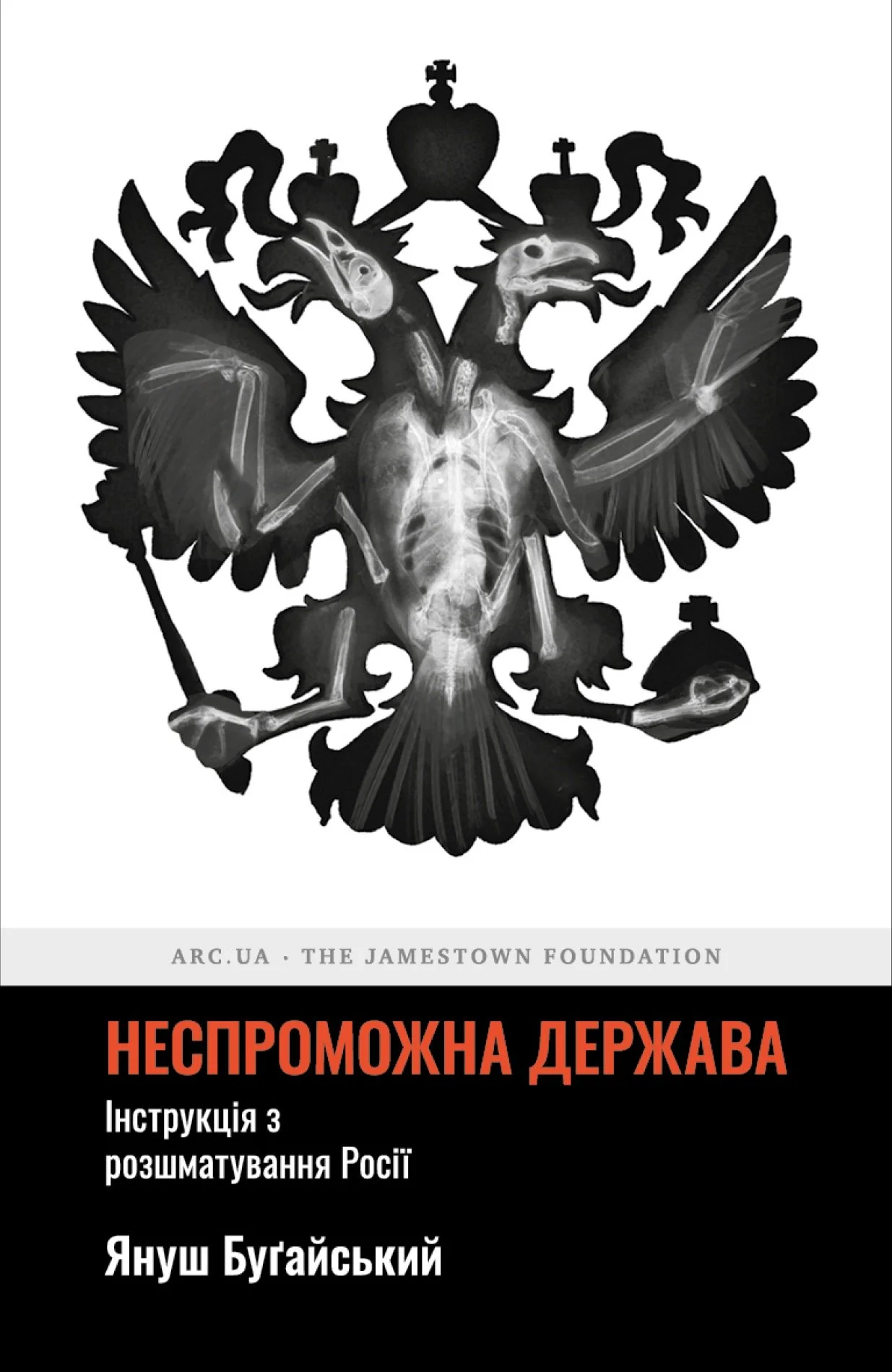
Failed State: A Guide to Russia’s Rupture
Неспроможна держава: Іструкція з розшматування Росії
Janusz Bugajski – Author
Maria Dubrova, Anna Melnychenko, Oleksandr Okhrimenko, Hanna Rak – Translators
Language of translation: Ukrainian
Publishers: Jamestown Foundation / ARC.UA
Janusz Bugajski / Author
In this book, Janusz Bugajski argues that the Russian Federation is not a stable successor to the Soviet Union but a failed state confronting profound structural and political decay. After three decades of failed efforts to transform Russia into a nation-state, a civic polity, or a sustainable empire, the federation remains built on fragile historical foundations and lacks a shared national identity capable of uniting its population. Instead, Russia is defined by deep internal conflict—between nationalists, imperialists, centralists, liberals, and federalists—alongside growing tensions between Moscow and the country’s regions and ethnic republics.
Bugajski traces Russia’s accelerating state failure to a convergence of long-term pressures: economic stagnation, widening social and regional inequalities, demographic decline, entrenched corruption, personalist rule, institutional distrust, and the erosion of public faith in official propaganda. As repression intensifies to preserve central control under deteriorating conditions, the risk of violent rupture increases.
The book contends that Vladimir Putin, who rose to power promising to prevent Russia’s disintegration, may ultimately be remembered as the leader who presided over it. As Moscow’s authority weakens, new territorial entities and proto-states are likely to emerge, shaped by regional, ethnic, and political revivals. These successor entities will follow divergent paths—some forming new states, others experimenting with federal or confederal arrangements—while border disputes and regional instability remain likely.
Bugajski concludes by examining the international consequences of a fragmenting Russia and the strategic choices facing the United States and its allies. He argues that managing Russia’s rupture will require supporting regional self-determination, strengthening the security of neighbouring states, coordinating with major powers, and promoting transatlantic engagement with emerging post-Russian entities.